
Ignoring Powell, traders are betting big on Fed rate cuts! Spot gold soars to 2072!
Spot gold prices surged at the beginning of the week, reaching $2050 on Wednesday before undergoing a corrective pullback. On Friday, it saw another significant rise, peaking at $2074 before closing at $2072. Multiple data releases this week indicated a decline in US inflation and a cooling labor market. While the economy remains robust, it is showing signs of slowing overall. The market disregarded statements from Federal Reserve officials expressing openness to further interest rate hikes, reinforcing expectations that the Fed will end its rate hike cycle, boosting gold prices and maintaining a strong trend for the third consecutive week. On Friday, spot gold opened at $2036.17 per ounce, reaching a high of $2074.36 and a low of $2035.20, before closing at $2072.13, a 1.77% increase. The weekly gain was 3.48%. Key Economic Indicators [Signs of a Weakening US Economy] The Fed's benchmark interest rate remains at its highest level in 22 years. Consumers are exhausted under the pressure of high interest rates and declining savings. Media reports suggest this is the clearest signal of slowing economic growth as we enter 2024. With a cooling labor market and slowing wage growth, the economy may face further challenges in the new year. Recent data shows the US ISM Manufacturing PMI at 46.7 in November, marking 13 consecutive months of contraction—the longest period in 20 years. The new orders index has contracted for 15 consecutive months, the longest such streak since 1981-1982. Additionally, monthly personal spending data released by the US government on Thursday showed a decrease in discretionary spending on items such as cars, furniture, and gym memberships in the fourth quarter. The holiday shopping atmosphere was less enthusiastic, with some of the largest US chains experiencing declining consumption during Black Friday, and a record proportion of online purchases using buy-now-pay-later schemes on Cyber Monday. James Knightley, ING's chief international economist, stated: "The disposable income side of things doesn't look good—employment growth is slowing, wages are slowing, and we're seeing consumers weakening, which is significant." [Market Ignores Powell's Hints of Potential Rate Hikes] With cooling inflation and a softening economy, the market has boldly anticipated Fed rate cuts. Even hawkish remarks from Fed Chair Powell haven't dampened this enthusiasm. On Friday, Fed Chair Jerome Powell countered market expectations of significant future rate cuts, stating that it's too early to declare victory over inflation. In prepared remarks for a speech in Atlanta, Powell said, "It's premature to assert that we've achieved a sufficiently restrictive stance or to speculate on when policy might be eased." However, he also noted that policy "is already in restrictive territory" and the Fed will proceed cautiously. Although Powell remains cautious, Jeffrey Roach, chief economist at LPL Financial, said: "The market sees today's comments as leaning dovish." Bond traders increased their bets on Fed rate cuts next year. They see an 80% chance of a rate cut as early as March, double the probability on Thursday. Financial journalist Nick Timiraos believes the December FOMC meeting will likely see the Fed hold rates steady, but don't expect officials to explicitly acknowledge the end of the rate hike cycle. The Fed may maintain hawkish forward guidance, implying that the next rate adjustment is more likely to be a hike than a cut. Officials will need time to observe whether inflation continues to cool or if the economy and slowing job growth underperform expectations.
Time:
2023-12-02 11:18
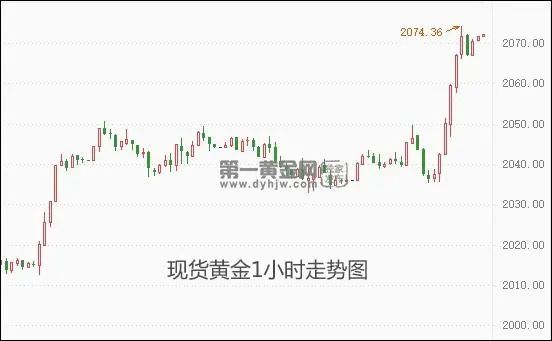
Spot gold surged at the beginning of the week, reaching $2050 on Wednesday before undergoing a corrective pullback. It then saw a significant rise on Friday, peaking at $2074 before closing at $2072. This week, multiple data points indicated a decline in US inflation and a cooling labor market. While the economy remains strong, it is showing signs of slowing overall. The market disregarded statements from Federal Reserve officials expressing openness to further interest rate hikes, reinforcing expectations that the Fed will end its rate hike cycle, boosting gold prices and maintaining a strong trend for the third consecutive week.
Spot gold opened on Friday at $2036.17 per ounce, reaching a high of $2074.36 and a low of $2035.20, closing at $2072.13, up 1.77%. The weekly gain was 3.48%.
Fundamental Focus
Signs of Weakness in the US Economy
The Federal Reserve's benchmark interest rate remains at its highest level in 22 years. Under the pressure of high interest rates and declining savings, consumers are exhausted. Media commentary suggests this is the clearest signal of slowing economic growth as we enter 2024. With a cooling labor market and slowing wage growth, the economy may face more challenges in the new year.
Recent data shows that the US ISM Manufacturing PMI was 46.7 in November, marking 13 consecutive months of contraction—the longest contraction in 20 years. The new orders index has contracted for 15 consecutive months, the longest such streak since 1981-1982.
Additionally, monthly personal spending data released by the US government on Thursday showed a decrease in discretionary spending on items such as cars, furniture, and gym memberships in the fourth quarter. The holiday shopping atmosphere was less enthusiastic, with some of the largest US chains experiencing declining consumption during Black Friday and a record proportion of online purchases using buy-now-pay-later plans on Cyber Monday.
James Knightley, ING's chief international economist, stated: "The household disposable income side doesn't look good—job growth is slowing, wages are slowing, and we're seeing consumers weakening, which is significant."
Market Ignores Powell's Retention of Rate Hike Possibility
With cooling inflation and a softening economy, the market has begun to boldly anticipate interest rate cuts by the Federal Reserve. Even hawkish remarks from Fed Chair Powell haven't dampened market enthusiasm for rate cuts.
On Friday, Federal Reserve Chairman Jerome Powell pushed back against market expectations of significant future rate cuts, stating that it is too early to declare victory over inflation.
In prepared remarks for a speech in Atlanta, Powell said, "It's premature to assert that we've achieved a sufficiently restrictive stance or to speculate on when policy might be eased." However, he also noted that policy "is already in restrictive territory" and that the Fed will proceed cautiously.
Although Powell remains hawkish in his statements, Jeffrey Roach, chief economist at LPL Financial, said, "The market sees today's comments as leaning toward the dovish camp." Bond traders increased their bets on Fed rate cuts next year. They see an 80% chance of a rate cut as early as March, double the probability from Thursday.
Financial journalist Nick Timiraos believes that the December FOMC meeting will likely see the Fed hold interest rates steady, but don't expect officials to explicitly acknowledge the end of the rate hike cycle. The Fed may maintain hawkish forward guidance, implying that the next rate adjustment is more likely to be a hike than a cut. Officials will need time to observe whether inflation continues to cool or if the economy and job growth slow more than expected.
Related News
Gold prices continue to fluctuate.
Gold prices have shown a volatile pattern in the short term, affected by the weakening of the US dollar and changes in sentiment due to easing geopolitical tensions.
Gold prices rise again! Multiple risks fuel safe-haven demand.
From the perspective of the international market, the tense situation in the Middle East, the escalation of the Russia-Ukraine conflict, and the continued high uncertainty surrounding the US Trump administration's tariff policies have driven up gold prices due to increased risk aversion in the market. Furthermore, a significant recent change in the gold market is that gold has become the second-largest reserve asset for central banks globally. How should the future trend of gold prices be viewed? Several analysts have indicated that in the short term, gold prices may fluctuate due to factors such as tariff easing and sudden changes in the geopolitical situation; in the medium to long term, gold prices are still in an upward channel.
As the Russia-Ukraine conflict enters its third year, global attention is once again focused on this geopolitical crisis. According to Dow Jones Newswires, US President Donald Trump made startling remarks at the White House on Thursday (June 5), stating that neither Russia nor Ukraine is prepared for peace, and that both sides may "continue fighting" until one side is willing to compromise. This statement not only signals the failure of his attempts to broker peace, but also introduces new uncertainty to the global geopolitical and economic markets.
Recently, good news came from the China Machinery Metallurgy and Building Materials Workers' Technical Association. In the 2025 National Machinery Metallurgy and Building Materials Industry Workers' Technological Innovation Achievement Award, Shandong Guoda Gold Co., Ltd.'s "Purification of Crude Arsenic Flue Dust to Produce Arsenic Trioxide Industrial Application" and "Key Technology Application for High-Value Utilization of Complex Copper-Gold Ore Resources" projects won the first prize and the second prize respectively. This honor is a high recognition of the workers' technological innovation ability and the effectiveness of achievement transformation, and also fully demonstrates the company's outstanding strength in the industry.
Gold prices return to $3300! Wall Street banks show significant divergence in long-term outlook
In fact, as gold prices fluctuate, Wall Street's major banks have recently shown a clear divergence in their views on gold prices. Unlike Goldman Sachs and Deutsche Bank, which are optimistic about gold's performance, Citigroup believes that the long-term outlook for gold prices is not optimistic.
Although gold prices rose this week, market volatility has clearly increased. While the US-UK agreement is symbolic, its content is limited and insufficient to alleviate concerns about a global economic slowdown. Therefore, gold prices will continue to fluctuate between safe havens and policy signals, closely monitoring the Federal Reserve's interest rate expectations and global trade sentiment.