

Gold prices plummeted after hitting a two-week high, as the market anticipates faster interest rate cuts by the Federal Reserve.
On Friday, August 2nd, during the New York trading session, gold prices reversed course and plunged nearly 1% after hitting a two-week high of $2477, due to weaker-than-expected US economic data. This put pressure on the dollar and caused US Treasury yields to plummet, as investors anticipated that the Federal Reserve might cut interest rates sooner than they had expected.
Time:
2024-08-03 11:18
On Friday, August 2nd, during the New York trading session, gold prices reversed course after hitting a two-week high of $2477, plummeting nearly 1% due to weaker-than-expected US economic data. This put pressure on the dollar and caused US Treasury yields to plunge as investors anticipated the Federal Reserve might cut interest rates sooner than expected.
Spot gold fluctuated as disappointing US economic indicators weighed on the dollar and US Treasury yields.
Friday's disappointing US non-farm payroll data left investors digesting the discouraging ISM Manufacturing PMI report, raising concerns about the health of the US economy.
The US Department of Labor revealed that 114,000 jobs were added in July, below the expected 175,000, with previous data revised down from 206,000 to 179,000. Further data showed the unemployment rate rising from 4.1% to 4.3%, and average hourly earnings falling from 0.3% to 0.2%, a decrease of one-tenth of a percent. Spot gold prices rose significantly as the US 10-year Treasury yield fell over 15 basis points to 3.815%. The dollar was also affected, US Dollar Index (103.2210, -1.1151, -1.07%), plummeting over 1.13% to 103.16. After the data release, most banks began to factor in expectations that the Federal Reserve would adopt a more aggressive monetary easing policy. Bank of America expects the Fed to cut rates for the first time in September rather than December, while Citi and JPMorgan Chase expect cuts of 50 basis points in September and November, respectively.
Spot Gold Price Analysis: Technical Outlook
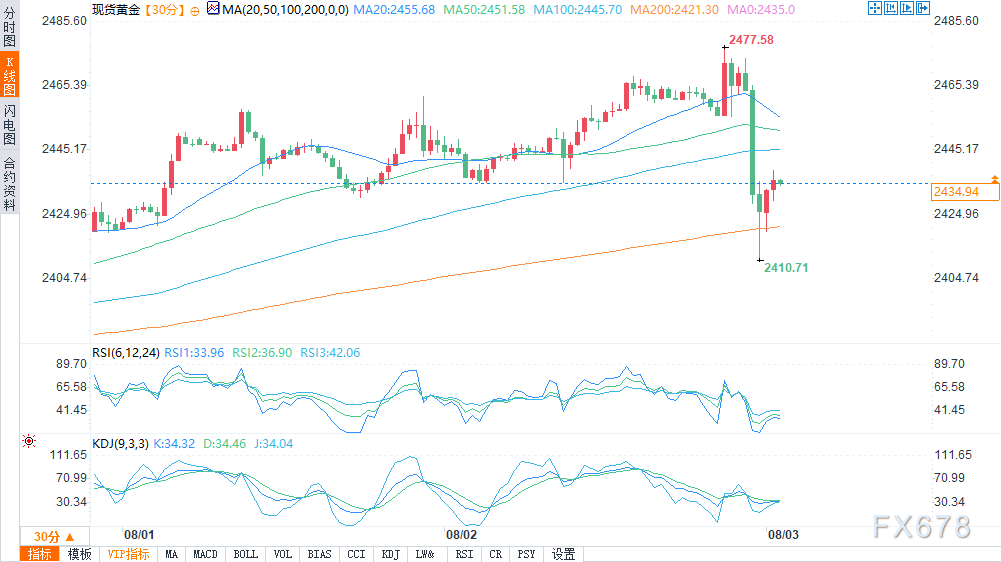
Spot gold has retreated to the July 31 low of $2404 - $2410, possibly due to profit-taking ahead of the weekend, as US Treasury yields and the dollar remain at their weekly lows. Technically, spot gold will remain bullish if buyers close above $2,450, which could intensify the challenge to historical highs before the $2,500 mark.
If prices weaken further, gold could fall below $2400, potentially paving the way for a pullback to the 50-day moving average of $2,364, then testing the 100-day moving average of $2337.
Related News
Gold prices continue to fluctuate.
Gold prices have shown a volatile pattern in the short term, affected by the weakening of the US dollar and changes in sentiment due to easing geopolitical tensions.
Gold prices rise again! Multiple risks fuel safe-haven demand.
From the perspective of the international market, the tense situation in the Middle East, the escalation of the Russia-Ukraine conflict, and the continued high uncertainty surrounding the US Trump administration's tariff policies have driven up gold prices due to increased risk aversion in the market. Furthermore, a significant recent change in the gold market is that gold has become the second-largest reserve asset for central banks globally. How should the future trend of gold prices be viewed? Several analysts have indicated that in the short term, gold prices may fluctuate due to factors such as tariff easing and sudden changes in the geopolitical situation; in the medium to long term, gold prices are still in an upward channel.
As the Russia-Ukraine conflict enters its third year, global attention is once again focused on this geopolitical crisis. According to Dow Jones Newswires, US President Donald Trump made startling remarks at the White House on Thursday (June 5), stating that neither Russia nor Ukraine is prepared for peace, and that both sides may "continue fighting" until one side is willing to compromise. This statement not only signals the failure of his attempts to broker peace, but also introduces new uncertainty to the global geopolitical and economic markets.
Recently, good news came from the China Machinery Metallurgy and Building Materials Workers' Technical Association. In the 2025 National Machinery Metallurgy and Building Materials Industry Workers' Technological Innovation Achievement Award, Shandong Guoda Gold Co., Ltd.'s "Purification of Crude Arsenic Flue Dust to Produce Arsenic Trioxide Industrial Application" and "Key Technology Application for High-Value Utilization of Complex Copper-Gold Ore Resources" projects won the first prize and the second prize respectively. This honor is a high recognition of the workers' technological innovation ability and the effectiveness of achievement transformation, and also fully demonstrates the company's outstanding strength in the industry.
Gold prices return to $3300! Wall Street banks show significant divergence in long-term outlook
In fact, as gold prices fluctuate, Wall Street's major banks have recently shown a clear divergence in their views on gold prices. Unlike Goldman Sachs and Deutsche Bank, which are optimistic about gold's performance, Citigroup believes that the long-term outlook for gold prices is not optimistic.
Although gold prices rose this week, market volatility has clearly increased. While the US-UK agreement is symbolic, its content is limited and insufficient to alleviate concerns about a global economic slowdown. Therefore, gold prices will continue to fluctuate between safe havens and policy signals, closely monitoring the Federal Reserve's interest rate expectations and global trade sentiment.