

Non-farm payroll data is coming! The report is expected to show the slowest hiring pace in years, could gold prices take off again?
The US October non-farm employment report will be released on Friday, November 1. The market expects that only 100,000 jobs were added in October, the lowest level in nearly four years. This is expected to provide further upward momentum for gold prices, potentially pushing them to new record highs.
Time:
2024-11-01 16:29
Huitong Finance APP News - Friday (November 1) will see the release of the US October non-farm employment report. The market expects that the number of jobs added in October will only be 100,000, the lowest level in nearly four years, which is expected to provide further upward momentum for gold prices , and may even push it to a new all-time high.
Strong hurricanes and large-scale labor strikes may significantly reduce the number of non-farm jobs in October, which is expected to be the slowest month of job growth in nearly four years.
According to a Dow Jones survey, economists expect: The US Bureau of Labor Statistics will report on Friday that, impacted by Hurricanes Helene and Milton, and the Boeing strike, only 100,000 jobs were added this month. If this prediction is accurate, this would be the lowest total employment since December 2020, a significant drop from 254,000 in September.
The report will be released at 8:30 PM Beijing time, and the unemployment rate is expected to remain unchanged at 4.1%.

Historical Data Overview (January 2022 - September 2024)
Michael Arone, chief investment strategist at State Street Global Advisors, said: "When we look at the employment data, the unemployment rate is expected to remain low, and I think wage growth will outpace inflation. Both of these data points will highlight the health of the US economy."
In terms of wages, average hourly earnings are expected to increase by 0.3% this month, up 4% year-on-year, the same year-on-year growth rate as in September, further confirming the argument that inflation is persistent but not accelerating.
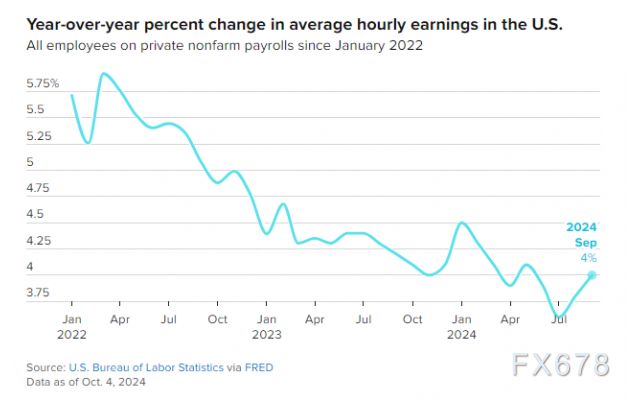
Historical Overview of Year-on-Year Salary Growth Rate
Regardless of the outcome, the market may selectively view this report, as various one-off events (hurricanes and strikes) have suppressed hiring.
Arone added, "The data may be a bit noisy, but I think there's enough information to continue to determine that a soft landing is still possible, and the US economy remains in good shape."
The hurricanes caused what may be historically high levels of property damage, while the Boeing strike has left 33,000 workers unemployed.
Goldman Sachs estimates that Hurricane Helene cut as many as 50,000 jobs, although Hurricane Milton may have formed too late to affect October's statistics. Meanwhile, the Boeing strike may have reduced the total number of jobs by 41,000, with Goldman Sachs predicting overall job growth of 95,000.
Other data has remained stable
Despite the impact of storms and strikes, the upcoming highly anticipated employment report shows that hiring activity continues to accelerate and the layoff rate is low.
The ADP report shows that private sector employment increased by 233,000 in October, far exceeding expectations. Meanwhile, initial jobless claims fell to 216,000, the lowest level since the end of April.
The White House estimates that these events combined may have reduced the total workforce by 100,000. "This disruption will make interpreting this month's employment situation more difficult than usual," said Jared Bernstein, chairman of the Council of Economic Advisers, on Wednesday.
Overall, post-pandemic employment data has been somewhat chaotic.
Earlier this year, the Bureau of Labor Statistics announced benchmark revisions, removing 818,000 people from previous statistics during the 12-month period ending March 2024. From the beginning of the year to July this year, these revisions have already reduced the initial estimates by 310,000.
"This report will reinforce the overall picture that the labor market is still growing. But the reality is that growth is slowing," said Julia Pollak, chief economist at ZipRecruiter. "Growth is slowing and becoming increasingly narrowly concentrated in a few sectors."
The main areas of job creation this year have been government, healthcare, leisure and hospitality. Pollak said this will continue, especially in healthcare, while ZipRecruiter is also seeing greater interest in the market for related businesses such as technology, finance and insurance.
However, she said the overall picture is that the market is slowing down and needs some help from the Fed to cut interest rates to prevent a downturn.
Pollak said: "Over the past two quarters, job growth has been below the pre-pandemic average, and the distribution of job growth has been unusually narrow. "This has a real impact on job seekers and employees, who feel their bargaining power is weakened, and many are struggling to find relatively ideal jobs. Therefore, I do believe the Fed should keep a close eye on the labor market."
Related News
Gold prices continue to fluctuate.
Gold prices have shown a volatile pattern in the short term, affected by the weakening of the US dollar and changes in sentiment due to easing geopolitical tensions.
Gold prices rise again! Multiple risks fuel safe-haven demand.
From the perspective of the international market, the tense situation in the Middle East, the escalation of the Russia-Ukraine conflict, and the continued high uncertainty surrounding the US Trump administration's tariff policies have driven up gold prices due to increased risk aversion in the market. Furthermore, a significant recent change in the gold market is that gold has become the second-largest reserve asset for central banks globally. How should the future trend of gold prices be viewed? Several analysts have indicated that in the short term, gold prices may fluctuate due to factors such as tariff easing and sudden changes in the geopolitical situation; in the medium to long term, gold prices are still in an upward channel.
As the Russia-Ukraine conflict enters its third year, global attention is once again focused on this geopolitical crisis. According to Dow Jones Newswires, US President Donald Trump made startling remarks at the White House on Thursday (June 5), stating that neither Russia nor Ukraine is prepared for peace, and that both sides may "continue fighting" until one side is willing to compromise. This statement not only signals the failure of his attempts to broker peace, but also introduces new uncertainty to the global geopolitical and economic markets.
Recently, good news came from the China Machinery Metallurgy and Building Materials Workers' Technical Association. In the 2025 National Machinery Metallurgy and Building Materials Industry Workers' Technological Innovation Achievement Award, Shandong Guoda Gold Co., Ltd.'s "Purification of Crude Arsenic Flue Dust to Produce Arsenic Trioxide Industrial Application" and "Key Technology Application for High-Value Utilization of Complex Copper-Gold Ore Resources" projects won the first prize and the second prize respectively. This honor is a high recognition of the workers' technological innovation ability and the effectiveness of achievement transformation, and also fully demonstrates the company's outstanding strength in the industry.
Gold prices return to $3300! Wall Street banks show significant divergence in long-term outlook
In fact, as gold prices fluctuate, Wall Street's major banks have recently shown a clear divergence in their views on gold prices. Unlike Goldman Sachs and Deutsche Bank, which are optimistic about gold's performance, Citigroup believes that the long-term outlook for gold prices is not optimistic.
Although gold prices rose this week, market volatility has clearly increased. While the US-UK agreement is symbolic, its content is limited and insufficient to alleviate concerns about a global economic slowdown. Therefore, gold prices will continue to fluctuate between safe havens and policy signals, closely monitoring the Federal Reserve's interest rate expectations and global trade sentiment.